
Common Ground for Tea Partiers and Liberals
 Friday, March 18, 2011 at 03:07PM
 We are accustomed to thinking of the US political spectrum as a linear spectrum from left to right and the need always to have a center-left coalition or a center-right coalition in order to elect Congressional majorities or to pass legislation. In this framework, left and right are polar opposites in terms of political philosophy. But what if the political spectrum is not a straight horizontal line but is shaped like a horseshoe?
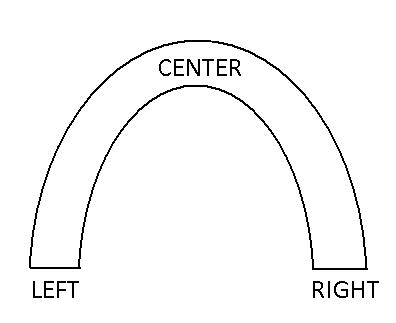 In this configuration, one can imagine a political polarization that is not left-right but is top-bottom based on economic class instead of political theory. The Tea Party representing the far right and socialists representing the far left both have strong populist sentiments, and both are angry that both major parties are effectively controlled by wealthy elites.
The Left has long feared Big Business and Wall Street and has tried to use government to check their power to exploit the lower economic classes.
On the other hand, Tea Partiers identify Big Government as the biggest threat to their interests. However, I suggest they react strongly against any powerful institution that intrudes negatively into their lives. They are anti-Wall Street and were very upset at the 2008-09 Bush-Obama bailout of the financial system. They are anti-free trade and very suspicious of MNCs and foreign companies and people, which our increasingly open borders largely benefit. And, despite their anti-government rhetoric, they are strongly in favor of Social Security and Medicare. They seem to feel that their lives are getting worse, not better, and that, rather than having control over their own lives, they are being dictated to and victimized by powerful people and institutions. They feel alienated from these shadowy forces and exploited by them--and that's not so different from how liberals feel.
Skeptic
My argument here is confirmed by a research paper from Princeton, which I link and quote from in More on the disproportionate political influence of the affluent.
Skeptic
Here is liberal Senator Sherrod Brown of Ohio saying he and libertarian Congressman Rand Paul of Texas tend to vote the same way on staying out of foreign wars, against free trade agreements, and against corporate welfare. (Rachel Maddow’s interview of Sen. Brown comes after the bin Laden porn stash story.)
Skeptic
It looks like Sarah Palin is trying to redefine the political divide in a similar way. As reported by Anand Giridharadas in NYT:
She made three interlocking points. First, that the United States is now governed by a “permanent political class,” drawn from both parties, that is increasingly cut off from the concerns of regular people. Second, that these Republicans and Democrats have allied with big business to mutual advantage to create what she called “corporate crony capitalism.” Third, that the real political divide in the United States may no longer be between friends and foes of Big Government, but between friends and foes of vast, remote, unaccountable institutions (both public and private).
. . . .
“This is not the capitalism of free men and free markets, of innovation and hard work and ethics, of sacrifice and of risk,” she said of the crony variety. She added: “It’s the collusion of big government and big business and big finance to the detriment of all the rest — to the little guys. It’s a slap in the face to our small business owners — the true entrepreneurs, the job creators accounting for 70 percent of the jobs in America.”
H/t Charlie for the link.
Skeptic
Professor Luigi Zingales of the University of Chicago Booth School of Business concurs in an op ed in today’s LAT, where he specifically identifies crony capitalism as the common enemy of the Tea Party and the Occupy Movement:
[Both major parties are ignoring] what unites the two movements: their fundamentally anti-elite, anti-establishment attitude.
The tea party and the Occupy movement both arose in response to pervasive frustration. As we've grown accustomed to hearing in recent years, Americans are angry. They're angry at bankers, who helped cause the financial crisis but paid no price for it. They're angry at Washington, which blamed the bankers but deserved as much blame, if not more, for failing to rein them in. And they're angry at an economy that seems to enrich the wealthy while leaving most everyone else standing still or falling behind.
This anger manifests itself in a strong anti-elite bias and a determination to resist an oppressive leviathan — though the monster takes different forms in the two movements. For the tea party, it's the federal government in Washington; for Occupy, it's bailout-addicted big business.
The difference is more apparent than real. The problem is not big business per se but monopolistic and politically powerful business. It is not government per se but intrusive and corrupt government. Is Fannie Mae inefficient, for example, because it is a large monopolistic company or because it is a state-sponsored enterprise? The answer is both.
Does the blame lie with the government or with the private sector? Neither. Their failures are the result of an increasingly corrupt system of crony capitalism, in which businesses succeed not through competitive merit but through government connections and favoritism such as tax breaks, subsidies and other preferential treatment.
For many people, the way big banks escaped the financial crisis with their profits intact (and often enhanced) epitomized American-style crony capitalism. Neither party has had the courage to confront it, for fear of losing campaign contributions and political power.
. . . .
The battle against crony capitalism is foremost a battle against anti-competitive, monopolistic corporations. Antitrust regulation should thus be extended to the political consequences of mergers. When companies become disproportionately big, they become disproportionately powerful, and as we have seen, their influence distorts the political system.
In no sector is this truer than in finance, where consolidation has made banks "too big to fail" and too powerful to combat. A reinstitution of the separation between commercial and investment banking, along the lines of the old Glass-Steagall Act (repealed in 1999), would help contain this excessive power.
It's worth keeping in mind that the patriots who threw English tea into Boston Harbor in 1773 were not revolting against higher taxes (the Tea Act, in fact, lowered the price of tea legally imported in America) but against the privileges granted to the British East India Co.. The American Revolution was a battle for political rights, but it was also a battle for economic freedom — and against an 18th century form of crony capitalism.
Corrupt arrangements of this kind have unfortunately endured to the present day, and their abuses finally sparked protest movements from the right and the left. The two political parties ignore these movements at their peril.
Skeptic
Priorities USA Action, a superpac supporting Obama's reelection, has assigned itself the task of defining Romney in a negative way. After rejecting "flip-flopper," "right wing extremist ideolog," and other approaches, they decided to define Romney as an out-of-touch super-rich elitist. As reported in the NYT Magazine--
Obama’s opponent was not an ideologue per se, the Priorities team decided, but instead someone who knows and cares only about wealthy Americans. Burton describes the distinction as “a top/bottom rather than left/right approach” — also known in Republican circles as class warfare.
Skeptic
Robert Reich explains it in similar terms here, four years later. He says this explains the popularity of both Donald Trump and Bernie Sanders. He predicts that neither will become President this year--
But the revolt against the ruling class won’t end with the 2016 election, regardless.
Which means the ruling class will have to change the way it rules America. Or it won’t rule too much longer.
Skeptic
Rick Smith develops the same top-bottom model here.
House Speaker Paul Ryan and establishment Republicans like Mitt Romney, and the Bush family seek to cast the battle for the soul of the Republican Party as an urgent rescue of true conservatism, the ideology of the Right. The Democratic establishment vocally fears that Senator Sanders will drag their party too far Left. But at its core, the power struggle in both parties is over control, over who will determine America’s policy agenda – the party establishment or a disenchanted and now rebellious middle class.
Skeptic
A Salon article criticizes the various explanations given by other pundits for why Trump and Sanders have so much suppport and concludes elites on the left and the right simply detest the underclass.
The Democratic Party has experienced two major left-wing revolts in the past four decades. The first was led by Jesse Jackson, who mobilized from a strong black base and tried but mostly failed to reach out to white workers. This year came Sanders, who started from a weak white base, expanded it, and tried but ultimately failed to win over enough black workers. There is no reason to think it unlikely that next time a candidacy with more foresight can be built from a youthful and multi-racial foundation— and then win over large swaths of both constituencies.
“It’s my sisters and brothers who have had their manufacturing jobs taken and pensions cut, who have a perpetual cycle of low wages,” Nina Turner, a former Ohio state senator and prominent black Sanders supporter told Meyerson. “I heard it from the white middle class, too…A white working-class man has the same concerns as a black working-class man.”
And this, I think, is what explains the elite liberal anxiety. If the Jackson and Sanders coalitions can join forces, the liberal elite become politically expendable. But insulting the white working class or trying to render it invisible won’t make it disappear.
Skeptic
In his NYT op ed today, David Leonhardt makes a good case for seeing the political world divided top-bottom over economics while social issues are still left-right.
Skeptic
It turns out the "horseshoe theory" was first articulated no later than the Weimar Republic, and has been used in writings by others since this post. "Proponents of Horseshoe Theory argue that the extreme left and the extreme right are closer to each other than either is to the political center." Wikipedia

Reader Comments (1)
skeptic -
I'm skeptical. You've identified certain, very specific areas of overlap. But the fundamental differences in world view between teabaggers and deep, fundamental, and numerous.
Teabaggers like Michelle Bachman, Ann Coulter and Rush Limbaugh and accept without question all of their pronouncements.
Progressives recognize that government is the only entity with the heft to stand up to trans-national corporations. Teabaggers are against socialized medicine, but want Medicare untouched. Bit of a perception problem, I'd say. Much of what they "know" is the
opposite of reality, and they are totally immune to facts and data.
Cheers!
JzB